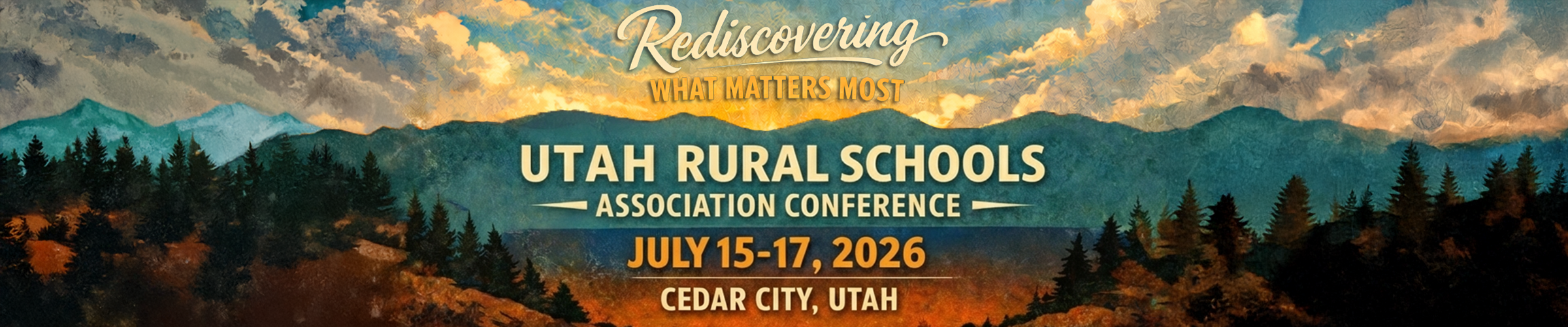
Welcome to URSA 2026 at Southern Utah University! All sessions will be in buildings on the upper campus (east end). Here’s the Campus Map (PDF) if needed.
WiFi: eduroam or SUU-Conference, password "summertimefun"
PLAN AHEAD - Tentative Future Conference Dates July 7-9, 2027 - Price, UT July 17-19, 2028 - Richfield, UT
🕒 Format Alert: This is a fast-paced, 20-minute showcase that is grouped together with two other quick sessions in this time block.
Buckle up for a high-speed tour of 20 actionable strategies designed to wake up your classroom. In just 20 minutes, we’ll do a full circle tour of of purposeful movement, structured talk, and seamless tech integration. You’ll leave this session with ready-to-use tactics that turn passive listeners into active participants.
Participants MUST HAVE one of the following platforms/devices in order to participate in this session: None
Participants MAY FIND IT USEFUL to have one or more of the following platforms/devices during this session: None
Digital Teaching & Learning Specialist, Canyons School District
Emma Moss is a Digital Teaching and Learning Specialist and AI Project Co-Lead in Canyons School District, as well as the Artificial Intelligence for K-12 Program Director in Utah. She founded the Utah AI Collaborative and leads monthly meet-ups on AI and innovation in education... Read More →
The 2026 Utah legislative session introduced major changes to school safety requirements, affecting emergency planning, threat assessment, reporting obligations, and coordination with law enforcement. This 60‑minute session distills the most important updates, clarifies new compliance expectations, and explains how these laws interact with existing state and federal guidance. Attendees will leave with a clear understanding of what has changed and practical steps for updating local policies and procedures.
Participants MUST HAVE one of the following platforms/devices in order to participate in this session: None
Participants MAY FIND IT USEFUL to have one or more of the following platforms/devices during this session: None
School Safety Center Specialist, USBE - Utah State Board of Education
Ashley Pistello joined the Utah State Board of Education (USBE) as the School Safety Center Specialist in 2023. She previously collaborated with the Utah School Safety Center as a liaison from SafeUT and the Huntsman Mental Health Institute (HMHI). In addition to her experience as... Read More →
We will explore the language arts curriculum for K-6 and integrate movement possibilities for students. Each lesson will be less than 10 minutes long and easily adapted to a classroom setting.
Participants MUST HAVE one of the following platforms/devices in order to participate in this session: None
Participants MAY FIND IT USEFUL to have one or more of the following platforms/devices during this session: None
Professional Development Director, University of Utah Tanner Dance
ASHLEY BOYACK received her BFA from the University of Utah and MAT from the University of Northern Colorado. She joined the Lawrence Arts Center in 2010, where she was Artistic Director of the Youth Dance Theater. While at LAC she created the modern dance curriculum and served as... Read More →
The landscape of secondary assessment in Utah is entering a phase of significant change. Following the passage of SB 39 (2025), the state is transitioning from the fixed-form Utah Aspire Plus (UA+) to a course-based, computer-adaptive High School RISE model for English Language Arts, Mathematics, and Science. For rural LEAs—where teachers often operate as "departments of one"—this shift introduces unique technical hurdles alongside powerful new data opportunities.This session provides a comprehensive roadmap for these upcoming changes, specifically addressing how the move from predictive, grade-based scores to adaptive, course-based reporting directly affects instructional planning. Unlike the previous model, the High School RISE model ensures that data is a precise reflection of the specific course being taught, offering rural educators a clearer picture of student mastery within their specific disciplines.We will dive deep into three primary challenges unique to the rural experience:Overcoming Professional Isolation: We provide "pre-packaged" formative tools and USBE resources, such as the Performance Task Writing Template, to reduce the burden of designing assessments from scratch.Managing Instructional Breadth: We demonstrate how course-based data empowers teachers who lead multiple subjects to refine instruction with subject-specific accuracy.Mitigating Data Volatility: We explain how the Computer Adaptive (CAT) model provides more statistically reliable measures in small cohorts, ensuring that individual outliers do not skew school-wide results.Attendees will leave equipped with a clear understanding of USETS and UTIPs, ready to leverage these state resources to support local needs and foster resilient, data-informed rural classrooms.
Participants MUST HAVE one of the following platforms/devices in order to participate in this session: None
Participants MAY FIND IT USEFUL to have one or more of the following platforms/devices during this session: None
Teresa McEntire is the Elementary ELA Assessment Specialist at the Utah State Board of Education. She has a master's degree in School Administration and a bachelor's in Elementary Education. She spent eleven years in the classroom in grades 3-6 and three years as an administrator... Read More →
Secondary Science Assessment Specialist, USBE - Utah State Board of Education
Sam Tinkey is a Secondary Science Assessment Specialist with USBE. She is an experienced educator and researcher with 11 years in Utah’s public school system, including eight years as a secondary science teacher. Her classroom experience informs her work in improving how instructional... Read More →
Join us as we explore insights from Utah educators on facilitating Career and Technical Education (CTE) participation for students with disabilities. Dive into the results of a comprehensive research study analyzing interviews and data from educators and administrators in Utah schools. As part of an ongoing research-practice partnership with the Utah State Board of Education (USBE), the Utah Education Policy Center (UEPC) conducted a study of facilitators and barriers to the representation of students with disabilities in CTE. The study sought to understand how facilitators and barriers differed among Local Education Agencies (LEAs). The findings and recommendations complement the USBE’s 2024-2029 Strategic Plan for Utah’s Secondary Career and Technical Education, which outlines the goals of Awareness and Outreach, Industry Alignment, Postsecondary Alignment, and Durable Skills. In addition, this research supports an understanding of how LEAs are ensuring students with disabilities are aware of and have access to educational opportunities, including those that prepare them for employment or career preparation (USBE Special Education Rules, 2023).
Participants MUST HAVE one of the following platforms/devices in order to participate in this session: None
Participants MAY FIND IT USEFUL to have one or more of the following platforms/devices during this session: Any of these
Tired of stalling out? It's time for a fresh SPARK of insight! In this high-energy session, you'll fan the flames of self-determination/self-advocacy; two powerhouse drivers of student success. We'll illuminate the connection between these strategies and the predictors of post-school success for students with disabilities.
This interactive session invites educators to reimagine Genius Hour, not just as a student-driven initiative, but as dedicated time for teachers to explore, design, and implement strategies that build student voice, choice, and independence. Participants will engage in their own Genius Hour experience, using that time to dive into resources, collaborate with peers, and create actionable plans to weave these powerful forces into your daily instruction across every grade level. Get ready to grab red-hot resources to fuel a future where every student is empowered to lead their own learning journey. Don't just teach – IGNITE their potential!
With a focus on empowering students from early childhood through secondary education, participants will learn to integrate self-determination and self-advocacy (SD/SA) into instruction using evidence-based practices linked to postschool success. This session explores strategies and resources that build SD/SA skills, showing how to embed them in developmentally appropriate, inclusive curricula. Instructional approaches will be connected to IDEA and ESSA requirements, to promote positive outcomes in employment, independent living, and postsecondary education. Through collaborative activities, participants will design actionable plans using practical tools and lesson ideas for immediate classroom use. By the end, attendees will gain concrete strategies to enhance student engagement, voice, and choice, and the confidence to implement SD/SA practices to support students with disabilities in reaching their full potential.
Participants MUST HAVE one of the following platforms/devices in order to participate in this session: Not Applicable
Participants MAY FIND IT USEFUL to have one or more of the following platforms/devices during this session: Mac Laptop, Windows Laptop, Android Tablet / Smartphone, iPad / iPhone, Windows Tablet / Smartphone
General idea- we will be providing simple and easy ideas of how you can increase engagement through organization, reading, technology and going old school with paper and pencil (we will provide more details).
Participants MUST HAVE one of the following platforms/devices in order to participate in this session: None
Participants MAY FIND IT USEFUL to have one or more of the following platforms/devices during this session: Any of these
🖼️ Format Alert: This is a relaxed, 2-hour "drop-in" poster session where you can browse at your leisure and chat informally with presenters.
It seems that education is one of the most over-politicized fields. Each year the legislature tries to "solve" all of "problems" they see in society by pushing more policies into the schools. Administrators play a big role in implementation for many of the top-down policies that are newly signed into law each year. Sometimes the laws make a little bit of sense. Sometimes they are just a nuisance. This poster session will discuss finding from my dissertation regarding policy implementation struggles and successes for school leaders. It will also give participants an opportunity to share their biggest policy struggles with me to guide my next research project because until practitioners and legislatures see each other, not much is going to change. Let's make policy work for Utah's rural school children!
Participants MUST HAVE one of the following platforms/devices in order to participate in this session: None
Participants MAY FIND IT USEFUL to have one or more of the following platforms/devices during this session: None
Bethany is a product of Utah's rural school system and this summer she will be completing her PhD in Education at Utah State University. She is interested in school leadership and education policy. Her career has been focused on language education, specifically Utah's dual language... Read More →
Thursday July 16, 2026 9:45am - 12:10pm MDT AU - Auditorium Foyer351 W. University Blvd., Cedar City, UT 84720
🛝 Format Alert: This is a fluid, 2-hour "drop-in" playground where you can stop by anytime to explore small-group activities at your own pace.
Join us for an engaging session on the Gold Medal Schools Program, a comprehensive initiative designed to promote healthy lifestyles, regular physical activity, and nutritious eating habits among students. Originally created to coincide with the 2002 Utah Olympics, this locally developed program is being re-established to align with the upcoming 2034 Olympic games, playing a key role in the state's broader Rural Health Transformation Plan.In this session, we will explore the core components of the proposed five-year Gold Medal Schools Pilot Program, which empowers eligible elementary schools to implement evidence-based strategies and create school policies that support lifelong health and wellnessLearning Intentions: Inform participants about the new Gold Medal Schools Program for rural schools, including grant opportunities.Demonstrate the framework (to be developed) and model activities that educators can implement as part of the program. Activities may include: nutrition education, fitness assessments, adaptive and inclusive sports, bike education, and active transport. Success Criteria: Participants have access to the framework and understand the requirements of Gold Medal Schools. They will also know how to apply for funding for the 2026-27 school year. Participants can lead and administer the activities modeled during the session with students.
Participants MUST HAVE one of the following platforms/devices in order to participate in this session: None
Participants MAY FIND IT USEFUL to have one or more of the following platforms/devices during this session: Any of these
🖼️ Format Alert: This is a relaxed, 2-hour "drop-in" poster session where you can browse at your leisure and chat informally with presenters.
School nurses provide important training, administrative support, advocacy, and direct carein a school setting. Professional organizations and state governments create recommendations on school nurse staffing that adequately support student health, safety, and learning. During the 2022 Utah General Legislative Session, House Bill 114 was passed which encourages having 1 school nurse for every 2,000 students in Utah schools.This poster presentation provides a map overview of the school nurse to student ratio and full-time equivalent hours needed to meet the Utah legislative ration recommendation as outlined in the 2025 School Health Workload Report. In the 2024-2025 school year, fewer than 3 out of 10 schools met the state's nurse to student ratio. This includes more than 523,900 students at 772 schools with a ratio higher than the 1:2,000 recommendation and 90 charter schools and 46,712 students with no school nurse-based health care coverage. Duchesne, Emery, and Cache counties have the highest student to school nurse ratios at 2 to 3 times recommendation. Many rural counties need to add less than 1 full time equivalent school nurse to meet the ratio recommendation.A high student to school nurse ratio can have many consequences in schools, such as decreased student attendance, decreased student academic performance, and increased time spent by principals, teachers, and office staff addressing student health concerns. About 82 FTE positions are needed for schools to meet the legislative recommendation across the state, with about 24 FTE positions needed for schools with no nurse.
Participants MUST HAVE one of the following platforms/devices in order to participate in this session: None
Participants MAY FIND IT USEFUL to have one or more of the following platforms/devices during this session: None
Epidemiologist/Evaluator, Utah Department of Health and Human Services
Mary Kathryn received her undergraduate degree in Health, Society, and Policy (2020) and Master of Public Health (2023) from the University of Utah. With an academic interest in human development, family studies, and community health, she assisted in several pediatric research studies... Read More →
Thursday July 16, 2026 9:45am - 12:10pm MDT AU - Auditorium Foyer351 W. University Blvd., Cedar City, UT 84720
🛝 Format Alert: This is a fluid, 2-hour "drop-in" playground where you can stop by anytime to explore small-group activities at your own pace.
This hands-on session gives educators practical ways to support students with challenging behavior by teaching communication (including AAC) as a replacement skill. You’ll learn to think about the “why” behind behavior and use that information to choose and teach simple, functional communication responses that fit your setting.We will use a Behavior Skills Training format (teach, model, practice, feedback) so you can try out strategies during the session and get feedback. You’ll leave with ready-to-use tools, including behavior observation sheets, function-based communication planning guides, AAC-friendly examples, and simple data sheets designed with rural schools in mind.This session is designed for general and special education teachers, paraprofessionals, counselors, and administrators. No behavior analysis background is needed—everything will be explained in plain, classroom-focused language with real examples.
Participants MUST HAVE one of the following platforms/devices in order to participate in this session: Mac Laptop; Windows Laptop; iPad / iPhone; Android Tablet / Smartphone; Windows Tablet / Smartphone; Chromebook
Rhea Rayomand Palkhiwala, MSE, LBA (UT), is a doctoral student in Disability Disciplines with an emphasis in Applied Behavior Analysis at Utah State University. She works as a school-based behavior consultant, supporting rural school teams with conducting function-based assessments... Read More →
Assistant Professor - Department of Special Education and Rehabilitation Counseling, USU - Utah State University
Dr. Audrey N. Hoffmann is an assistant professor in the Department of Special Education and Rehabilitation Counseling at Utah State University. Dr. Hoffmann provides services to individuals with intellectual or developmental disabilities and/or challenging behavior. She specializes... Read More →
Thursday July 16, 2026 9:45am - 12:10pm MDT AU - Auditorium Foyer351 W. University Blvd., Cedar City, UT 84720
🕒 Format Alert: This is a fast-paced, 20-minute showcase that is grouped together with two other quick sessions in this time block.
Information on services we provide and how individuals and providers can refer people for those services. We are a community provider specializing in psychotic episodes in individuals aged 15-25. Our services are available at no cost, as we are grant funded. We have done a lot of outreach in Cedar City and Iron County, and would love the chance to increase our circle of support as well as inform about similar programs state wide.
Participants MUST HAVE one of the following platforms/devices in order to participate in this session: Windows Laptop
Participants MAY FIND IT USEFUL to have one or more of the following platforms/devices during this session: Windows Laptop
🕒 Format Alert: This is a fast-paced, 20-minute showcase that is grouped together with two other quick sessions in this time block.
The Utah Division of Arts & Museums administers two different statewide competitions for 9-12 grade students designed to bring poetry to life for young learners while advancing literacy, confidence and public speaking skills.
Poetry Out Loud is a nationwide contest that starts at the local level with individual classrooms and schools. Lesson plans and other teacher resources are available to help teachers integrate the contest into their curriculum. Participating schools can request free on-site workshops with the state poet laureate. Students select from a collection of great works of poetry to memorize and recite, and local contest winners move on to the regional and then the state level, where cash prizes are awarded, and one Utah student will get a free trip to Washington D.C. for the national finals to compete for the $20,000 grand prize.
We also hold a statewide poetry writing competition called Poetry Ourselves. Students are encouraged to enter their own original works in both English and Spanish. Free workshops on bilingual poetry are available from our agency to encourage engagement from language learners in your school. Winners receive cash awards and a trip to Salt Lake to read their work at the state finals event in March.
We are committed to expanding this program to every corner of the state. Join us to learn how you can participate in the coming year.
Participants MUST HAVE one of the following platforms/devices in order to participate in this session: Not Applicable
Participants MAY FIND IT USEFUL to have one or more of the following platforms/devices during this session: Not Applicable
Arts Education Program Manager, Utah Division of Arts and Museums
Reilly is an arts educator, teaching artist, and archaeologist with a focus on community and heritage collaboration. She holds an M.F.A. in Community-Based Arts Education from the University of Utah, an M.A. in Middle Eastern Studies, and a B.S. in Anthropology. Her research explores... Read More →
Arts Education Coordinator, Utah Division of Arts & Museums
Justin Ivie is an accomplished theatre artist and a familiar face on Utah stages with hundreds of acting credits at companies all around the state. He is also a director, stage manager and theatrical designer.
Justin has been with the Utah Division of Arts & Museums since 2022 whe... Read More →
🕒 Format Alert: This is a fast-paced, 20-minute showcase that is grouped together with two other quick sessions in this time block.
Trello uses kanban board style task management to help quickly visualize tasks and organize steps in a process. I will demonstrate the basics of the kanban approach and how I specifically use Trello to manage my technology-related tasks for our district. If time permits, I will also show some automation tools that help make the product work even better to reduce the time I spend managing my time.
Participants MUST HAVE one of the following platforms/devices in order to participate in this session: None
Participants MAY FIND IT USEFUL to have one or more of the following platforms/devices during this session: Any of these
Christijan Draper graduated from high school in the Alaskan Bush as a class of one—valedictorian by default. Dr. Draper has a PhD in instructional psychology and technology, a MS in youth and family recreation, and he studied communications as an undergrad. He spent five years as... Read More →
Participants explore how the Holocaust Learning Experience is teaching resiliency, empathy, and character development through the lens of the Holocaust. Educators learn how the program impacts students and teachers by fostering understanding, encouraging individuals to stand up for others, and helping transform generations to confront hate, bigotry, bias, and antisemitism.
Top Three Learning Objectives · Learn how The Holocaust Learning Experience (HLE) a free resource to any school district, has filled a gap in traditional Holocaust Education. · Learn how the HLE program has impacted students, how fast it is growing and how easy it is to implement. · Hear how the HLE has curated Holocaust and genocide related information from all of the scholarly resources that educators are typically sent to in order to create their own lesson plans.
Being a teacher "in the middle" (6-8/9 grades) is a unique place to be. During this session we will look at how we are engaging with our students at this age. What are their unique developmental needs and how do we empower their learning while keeping our sanity.
Participants MUST HAVE one of the following platforms/devices in order to participate in this session: None
Participants MAY FIND IT USEFUL to have one or more of the following platforms/devices during this session: Any of these
Join us for an insightful presentation on Personalized Competency-Based Learning (PCBL) to explore effective strategies for enhancing student learning. You'll learn to set clear learning goals, establish measurable objectives, and leverage intrinsic motivators to foster a personalized learning environment. The session will also cover goal-setting, progress monitoring, and curating resources, providing practical strategies you can immediately implement in your classroom.
Participants MUST HAVE one of the following platforms/devices in order to participate in this session: Mac Laptop; Windows Laptop; Android Tablet / Smartphone; iPad / iPhone; Windows Tablet / Smartphone; Chromebook
Participants MAY FIND IT USEFUL to have one or more of the following platforms/devices during this session: Mac Laptop; Windows Laptop; Chromebook
Kayla Towner is a Senior Product Trainer at the Utah Education Network (UEN) and, first and foremost, a passionate educator. She loves spending time with her family—playing soccer ⚽️, reading books 📚, hiking 🥾, and adventuring across Utah 🏔️. Kayla is dedicated to... Read More →
There are a myriad of resources identifying best practice in secondary transition for students with disabilities. It can be challenging for practitioners, students, and families to visualize and implement these resources in a meaningful way. Additional resources are needed to help stakeholders identify meaningful opportunities, experiences, services, and supports to implement the postsecondary transition planning process with compliance and high quality. Utah's Portrait of a Graduate defines 13 competency areas essential for success in adult life. Utah’s Statewide Collaborative on Improving Postsecondary Transition Outcomes for Students with Disabilities (STC) recognized that students with disabilities often need additional support and services to achieve these same competencies as their peers without disabilities. Over the past year and a half, the STC has gathered insights on best practices, identified necessary skills for postsecondary success, and learned from the experiences of youth with disabilities. The result? The Portrait of Secondary Transition (POST) as a companion to the Portrait of a Graduate. This has been a long-term, multi-agency, collaborative process designed to affect whole-system change in how we serve young people with disabilities as we help them prepare for life as adults.This session will share our journey, lessons learned and inspire you to build on this work in your own setting. Don't miss this opportunity to explore our multi-tiered model and discover practical strategies to support young people with disabilities as they prepare for life as adults. Let's make a difference together!
Participants MUST HAVE one of the following platforms/devices in order to participate in this session: None
Participants MAY FIND IT USEFUL to have one or more of the following platforms/devices during this session: None
As part of my work with the district, I sit on a multi-disciplinary team that focusses on preventive measures to help students and adults make healthy life-style choices. In that work, we have talked a lot about Adverse Childhood Experiences (ACE's), and the lasting impact that trauma can have on one’s life. We have also spent considerable time looking at Positive Childhood Experiences (PCE's), and have learned that they may have a more lasting impact on health and behavior than do ACE’s. One study concluded that “Regardless of the number of ACE’s, PCE’s were associated with lower odds of having mental, emotional, developmental, and behavioral conditions…” (2025 Study of 2022 National Children’s Health Data; 23,133 children). This leads us to believe that The Positive has a lasting impact on each of us! The work of Positive Childhood Experiences is centered in seven areas of which four are directly tied to schools: “enjoying participation in community events; having at-least two non-parent adults who took genuine interest in you; feeling supported by friends; and feeling a sense of belonging in high school.” From this work, it is evident that the experiences a child has in school can and will have a lasting positive impact in their life, to the point that it can outweigh their adverse experiences. But it doesn’t stop there, research is being conducted that shows that the effect of The Positive continues into adulthood and that positive adult experiences, the ones you and I experience in the seasons of our careers as we interact with students in our spheres of influence, may help us to overcome and persevere through life's challenges.In this session, we will look at experiences and interactions from throughout my career, and those of my colleagues, that demonstrate how public schools truly are a setting where students are able to interact with trusting adults in a way that builds resilience and capacity. We will see that in many instances it is because of people like you, dedicated educators, that students obtain the relational resilience they need to overcome adverse childhood experiences. We will reflect together on experiences in our careers where we have been positive influences in the lives of students and together increase our resolve to persevere in this amazing journey of investing ourselves in the lives of young people.
Participants MUST HAVE one of the following platforms/devices in order to participate in this session: None
Participants MAY FIND IT USEFUL to have one or more of the following platforms/devices during this session: Any of these
Human Resources Director, Duchesene County School District
Phillip Bertoch grew up in Duchesne County and graduated from Union High School in 1987. He is the product of rural schools and understands the unique challenges and opportunities that come from living in, and being educated in, a rural community. He is a thirty year career educator... Read More →
🕒 Format Alert: This is a fast-paced, 20-minute showcase that is grouped together with two other quick sessions in this time block.
Empower your multilingual learners! In this session, you'll master essential AI tools for communication. We'll cover document translation using Canva, instant live captions with Google Meet and Class Tools, and creating scaffolded activities that align with language goals using the SchoolAI Chrome Extension and Gemini. Additionally, we'll detail a replicable welcome packet complete with community resources for your newcomers. Leave with immediately applicable strategies to use with your multilingual tomorrow.
Participants MUST HAVE one of the following platforms/devices in order to participate in this session: None
Participants MAY FIND IT USEFUL to have one or more of the following platforms/devices during this session: Any of these
Digital Learning Specialist, Jordan School District
Kelli Cannon has been an educator for 12 years, teaching upper elementary students prior to her current role as a Digital Learning Specialist. Kelli holds a Master’s Degree in Educational Technology, as well as endorsements in STEM, Teaching English as a Second Language and Instructional... Read More →
🕒 Format Alert: This is a fast-paced, 20-minute showcase that is grouped together with two other quick sessions in this time block.
I will be sharing my student's story. How I advocated for my student with admin and families, and how that communication helped everyone be on the same page. How my team and I set up safety and regulation spaces and supports. What we learned using them thoughtfully. Strategies I used to support my staff (building buy-in, navigating tough days, dealing with all the "real-life" variables like staffing and schedules). Data collection that is simple and realistic so you are able to see patterns and ask for the right kinds of support.
Participants MUST HAVE one of the following platforms/devices in order to participate in this session: None
Participants MAY FIND IT USEFUL to have one or more of the following platforms/devices during this session: None
Special Education Teacher, Blanding Elementary School
Meeting the needs of Complex Learners in rural areas with limited supports. Sharing my student’s story (in a de-identified way) to show the impact of significant needs and challenging behavior on the classroom.How I advocated for my student with admin and families, and how communication... Read More →
Rhea Rayomand Palkhiwala, MSE, LBA (UT), is a doctoral student in Disability Disciplines with an emphasis in Applied Behavior Analysis at Utah State University. She works as a school-based behavior consultant, supporting rural school teams with conducting function-based assessments... Read More →
In this session, we will share how data, assessments, and grading can be intentionally designed to focus on student centered learning, provide an accurate picture of student strengths and areas for growth, and accurately communicate student proficiency to stakeholders using systems and processes each clearly understand and connect with.
Participants MUST HAVE one of the following platforms/devices in order to participate in this session: None
Participants MAY FIND IT USEFUL to have one or more of the following platforms/devices during this session: Any of these
Director of Learning & Innovation, Washington County School District
I am the Director of the Learning & Innovation Technologies Division for the Washington County School District. I serve on the National Future Ready Schools Advisory Committee, the Utah Digital Learning Advisory Committee, & the National McGraw-Hill Literacy Advisory Committee. I... Read More →
🧠 Format Alert: This is an immersive, 2-hour deep-dive workshop designed for intensive, uninterrupted coverage of this topic.
Looking to bring more creativity into your classroom without the mess or stress? In this hands-on workshop, elementary classroom teachers will learn practical tips and tricks for confidently using and managing basic art supplies. From watercolors to oil pastels colored pencils and more, we’ll explore what’s worth buying, what to skip, and how to get the most out of the supplies you already have. How can you use and manage these supplies more effectively?Participants will learn art hacks for the classroom that will minimize chaos and maximize instructional time. We’ll also cover easy-to-teach techniques that help students use supplies correctly and responsibly, saving money and reducing waste. Whether you’re art-loving or art-avoidant, you’ll leave with ready-to-use strategies that make creative activities smoother, more efficient, more successful and more engaging.Perfect for any teachers who want big creative impact with basic supplies!
Participants MUST HAVE one of the following platforms/devices in order to participate in this session: None
Participants MAY FIND IT USEFUL to have one or more of the following platforms/devices during this session: None
BTS Arts Integration Coach, NUES - Northeastern Utah Educational Services
Liz Brown is a BTS Art Integration Coach for NUES. She was the 2025 Utah Art Educator of the Year for the National Art Education Association and the 2024 Art Educator of the Year for the Utah Art Education Association. She is passionate about arts integration and children getting... Read More →
🧠 Format Alert: This is an immersive, 2-hour deep-dive workshop designed for intensive, uninterrupted coverage of this topic.
In this 2 hour interactive presentation, UURC staff will demonstrate brief examples of the high quality, evidence-based, effective intervention services that can be provided to students at home or in school in rural areas across the state of Utah, providing a breakdown and analysis of the instruction provided at varying developmental reading levels with case studies to show data-based decision making. In this demonstration, participants will see scaffolded reading support in connected text across varied text complexities, as well as with words in isolation, connected with writing, and repeated reading procedures crafted to increase student fluency outcomes.
Participants MUST HAVE one of the following platforms/devices in order to participate in this session: None
Participants MAY FIND IT USEFUL to have one or more of the following platforms/devices during this session: Any of these
Reading Intervention Specialist, University of Utah Reading Clinic
Breyanna Evans received her B.S. in creative writing from Utah Valley University. Upon graduating, Breyanna worked as a reading intervention aide at Pinnacle Canyon Academy while she obtained her teaching license. She taught secondary English for three years, first for Pinnacle Canyon... Read More →
Today's middle school student is not the same as the middle school student of 15, 10 or even 5 years ago. The social, emotional and intellectual development of our young teens is an aspect we need to understand so that we can serve them better in our classrooms.
Participants MUST HAVE one of the following platforms/devices in order to participate in this session: None
Participants MAY FIND IT USEFUL to have one or more of the following platforms/devices during this session: Any of these
In this fast-paced, practical breakout, you’ll learn 10 simple, no-extra-prep strategies that get students out of their seats, thinking, talking, and engaging — without sacrificing rigor or losing control of your class. These ideas work in secondary settings (yes, even with high schoolers), align with instructional goals, and can be implemented tomorrow.Secondary classrooms weren’t designed for stillness… but somehow we’ve all ended up there. If you’ve ever looked out at a room full of slumped shoulders, tired eyes, and students who seem physically present but mentally somewhere else — this session is for you.The good news? You don’t need elaborate stations, complicated rotations, or hours of planning to bring energy back into your classroom. You just need movement — the right kind, at the right moments.We’ll explore how purposeful movement increases attention, improves retention, and strengthens classroom culture — especially during long block periods. You’ll leave with simple movement routines you can drop into any content lesson.If you’re ready to rediscover what matters most — real engagement, real energy, and real learning — it’s time to move it. Come ready to participate. (Yes, you’ll be moving too.)
Participants MUST HAVE one of the following platforms/devices in order to participate in this session: None
Participants MAY FIND IT USEFUL to have one or more of the following platforms/devices during this session: None
Mary Saylor is a secondary ELA teacher turned Instructional Coach who is passionate about helping teachers create engaging classrooms without adding hours of extra work. With 16 years of classroom experience, she shares practical strategies, mindset shifts, and classroom systems that... Read More →
In public education, the relationship between a special education teacher and a parent is more than just a professional requirement -- it is the foundation of a student's support system. In close-knit, rural communities, these interactions often extend beyond the classroom, making the establishment of authentic long-term trust both a unique challenge and a significant opportunity. When a genuine partnership is formed, the focus shifts from mere legal compliance to a shared mission of student success. This interactive session, led by two veteran special education teachers and current Utah Teacher Fellows, explores practical, high-impact strategies for fostering trust that endures. We will discuss how to move beyond the formality of the annual IEP meeting to create an ongoing dialogue that honors the parent's lived expertise and the teacher's professional dedication. Participants will engage with three pillars of family partnership:The Anatomy of Trust: Identifying specific communication habits that build–or inadvertently break–rapport with families.Conflict to Collaboration: Utilizing restorative communication techniques to navigate disagreements and turn difficult conversations into collaborative breakthroughs.Measurable Outcomes: Examining how robust home-school bonds lead to increased student engagement, higher teacher efficacy, and a more supportive school culture. Attendees will leave with a practical toolkit of communication templates and “parent-friendly” guides designed to bridge the gap between classroom goals and the home environment, ensuring every stakeholder feels heard, valued, and empowered.
Participants MUST HAVE one of the following platforms/devices in order to participate in this session: None
Participants MAY FIND IT USEFUL to have one or more of the following platforms/devices during this session: Any of these
Shannon Neeley originally hails from Virginia. She and her family found the Rockies calling and relocated to Utah in 2019. There she shifted from training adults to return to college as a first generation student to obtain her Bachelor of Science degree in Special Education. She graduated... Read More →
Sydney Whatcott is an accomplished Special Education teacher with nine years of experience dedicated to creating a high-quality, equitable learning environment for students. Currently, she teaches Kindergarten through 3rd-grade students at West Elementary in the Tooele County School... Read More →
Grade retention refers to the practice of requesting that a child repeat a grade or to the postponement of entry into kindergarten or first grade. It has been practiced for generations in schools in the United States. High stakes testing, increased educational accountability, escalating curriculum, and multifaceted sectors of pressure have amplified the practice of grade retention despite mixed evidence of the efficacy related to this highly investigated practice. What does the research say, and what are other options? This session reports research findings across time and explores alternatives to the practice that has been part of the educational landscape for over a century.
Participants MUST HAVE one of the following platforms/devices in order to participate in this session: None
Participants MAY FIND IT USEFUL to have one or more of the following platforms/devices during this session: None
Dean and Professor in the Beverley Taylor Sorenson College of Education and Human Development, SUU - Southern Utah University
Dr. Pam Powell spent over two decades as an elementary teacher prior to her appointment in higher education at Northern Arizona University. While there, she served as Chair of the Department of Teaching and Learning and as Associate Dean of the College of Education. In the state of... Read More →
Utah Middle Level Association will be facilitating a round robin/speed dating (but no actual dates) type of brainstorming session. Some of the best ideas of how to solve a problem are being used by someone else who is working in a middle/junior high school. You have a solution to someone else's challenge. Middle School Educators let's unite!
Participants MUST HAVE one of the following platforms/devices in order to participate in this session: None
Participants MAY FIND IT USEFUL to have one or more of the following platforms/devices during this session: Any of these
This session provides a practical, strategy-based guide for educators to navigate the 2026 updates to Utah’s sensitive materials laws. We will focus on the professional standards used to develop high-quality classroom and library collections that align with both state law and Utah Core Standards.Participants will learn how to apply objective selection rubrics to ensure new materials are age-appropriate and educationally relevant. We will explore how to stay current with the USBE statewide tracking system and how to handle the local review process with transparency and professional clarity. Whether you manage a school library or a personal classroom collection, you will leave with the tools to build a compliant, high-quality environment.
Participants MUST HAVE one of the following platforms/devices in order to participate in this session: None
Participants MAY FIND IT USEFUL to have one or more of the following platforms/devices during this session: Any of these
K12 Library Media Specialist, USBE - Utah State Board of Education
Davina Sauthoff, EdD. is the Library Media Specialist for the Utah State Board of Education. She loves reading, 📚 spending time with family 💟 which includes two pups. She is passionate about leveraging the expertise of school 🏫 librarians and the vital role the school... Read More →